Who Can Legally Administer Botox in Canada? Licensing Requirements Explained

Botox demand in Canadian clinics is not slowing down. Every week, more clinics want to expand their injectable offerings. The question is rarely about demand. It is about who on your team can legally hold that syringe.
Here is the direct answer: Botox is a controlled act in Canada. Only regulated health professionals can administer it legally. Provincial regulatory bodies define who qualifies, and the rules differ across provinces.
So Who Is Actually Authorized to Inject Botox?
The following professionals hold authorization under Canadian law:
- Physicians (MDs) can independently administer Botox in every province.
- Nurse Practitioners can inject independently in most Canadian provinces too.
- Registered Nurses may administer Botox, but usually need a physician’s order.
- Dentists are authorized in several provinces for facial and perioral applications.
- Naturopathic Doctors hold authorization in British Columbia and Alberta specifically.
- Licensed and Registered Practical Nurses face the most variation province to province.
One rule applies across every category above. Botox is a prescription drug — full stop. A prescribing authority must assess the patient before any injection happens. That means a physician or NP must be part of the process. No prescription, no legal injection. It is that straightforward.
Why Are the Rules So Different Across Provinces?
Healthcare regulation in Canada is a provincial responsibility. There is no single national body governing who injects what. Each province runs its own regulatory colleges. Each college defines professional scope of practice independently.
Ontario administers controlled acts under the Regulated Health Professions Act. British Columbia governs health professions under its own Health Professions Act. Alberta uses a separate framework with its own college oversight structure. The same nurse may have different obligations depending on which province they work in. What is permitted in Alberta without a physician present may require stricter oversight in Ontario. Clinic owners operating across provinces need to understand this clearly.
Can Estheticians or Cosmetologists Ever Administer Botox?
No. There is no grey area here at all. Botox carries a Drug Identification Number as a prescription drug. Estheticians and cosmetologists are not regulated health professionals under provincial law. No training certificate from a non-regulated program changes that fact. Allowing unlicensed staff to inject — even under the same roof — creates serious exposure. Regulatory action, criminal liability, and patient harm are all real risks. Clinic owners need to draw this line clearly and hold it.
What Does Delegation Actually Mean in Practice?
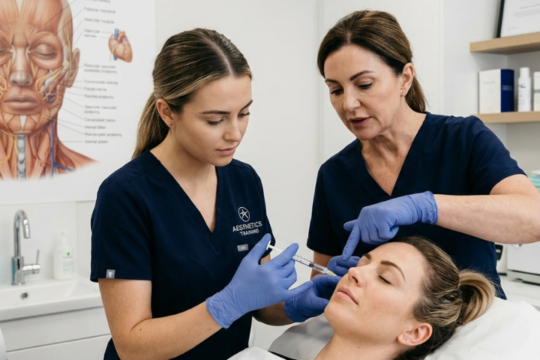
Many clinics run on a delegation or directive model. A physician or NP authorizes a nurse to perform the injection. This is legal, but only when specific conditions are met. A valid order or directive must exist in writing. The delegating professional must have assessed the patient directly. The person injecting must have documented competency for the procedure. The supervision model must meet the relevant college’s specific standards.
Delegation is not a shortcut or a workaround for staffing. It is a structured clinical process with documentation requirements. If it cannot be defended in a college complaint, it was not done correctly. Training is central to making delegation hold up.
Why Does Training Matter Beyond Just Meeting the Legal Minimum?
Meeting the minimum legal requirement gets you into practice. It does not protect you when a complication arises. Botox carries real risks — vascular occlusion, ptosis, asymmetry, and systemic spread. Practitioners who understand facial anatomy at a clinical level manage complications better. They identify contraindications before problems happen, not after. They document accurately and communicate clearly with patients.
Regulatory colleges are also looking more closely at practitioner training records. A college complaint now often triggers a review of the practitioner’s competency documentation. Formal, recognized training in medical aesthetics carries weight in that process. Informal mentorship or observation does not carry the same credibility. The gap between those two outcomes is significant.
How Do You Keep Your Clinic Compliant Going Forward?
Compliance is not a task you complete once and file away. It requires active attention as regulations and college guidelines change. A few practices worth building into your clinic operations:
- Verify every injector’s credentials are current and appropriate for your province.
- Keep documentation of all delegation orders and patient assessment records.
- Ensure your team holds formal, recognized training in medical aesthetics.
- Review your provincial college’s published guidelines on an annual basis.
- Work with legal counsel familiar with health professions law when needed.
Clinic owners who treat compliance as ongoing practice management rarely get caught off guard. Those who treat it as a one-time setup tend to find out the hard way.
The professionals on your team are either your strongest asset or your biggest exposure. The difference often comes down to their training.
Ready to formalize your team’s credentials? NAIMA’s medical aesthetics programs are built for regulated health professionals who want clinical depth, not just a certificate.


Comments are closed.